


Tralee is the round that changes a County Kerry golf trip from a collection of famous names into a route. It sits naturally between Ballybunion to the north and Waterville farther south, but the course is more than a convenient stop between them.
The front nine plays across more open coastal ground with Tralee Bay and the Atlantic constantly in view. The back nine enters much larger dunes, where the holes become more enclosed, elevated and severe. That contrast is the identity of the course.
A Tralee golf trip should give the course a full day rather than squeezing it between long transfers.
Quick Answer
Plan one full day for Tralee and stay one or two nights in the area. One night works when the group is moving directly from Ballybunion toward Waterville. Two nights are better when Tralee is used as a central Kerry base or when the group wants a less rushed schedule around the round.
Tralee is a walking course, and its back nine crosses demanding terrain. Avoid placing another difficult walking round or a long transfer immediately after it when the itinerary has room to breathe.
The Arnold Palmer Course
Tralee Golf Club was founded in 1896, but the current course at Barrow opened in 1984. It was Arnold Palmer's first European design, created with Ed Seay on a coastal site Palmer considered ideally suited to golf. Later work from Donald Steel and Tom MacKenzie helped develop the course further.
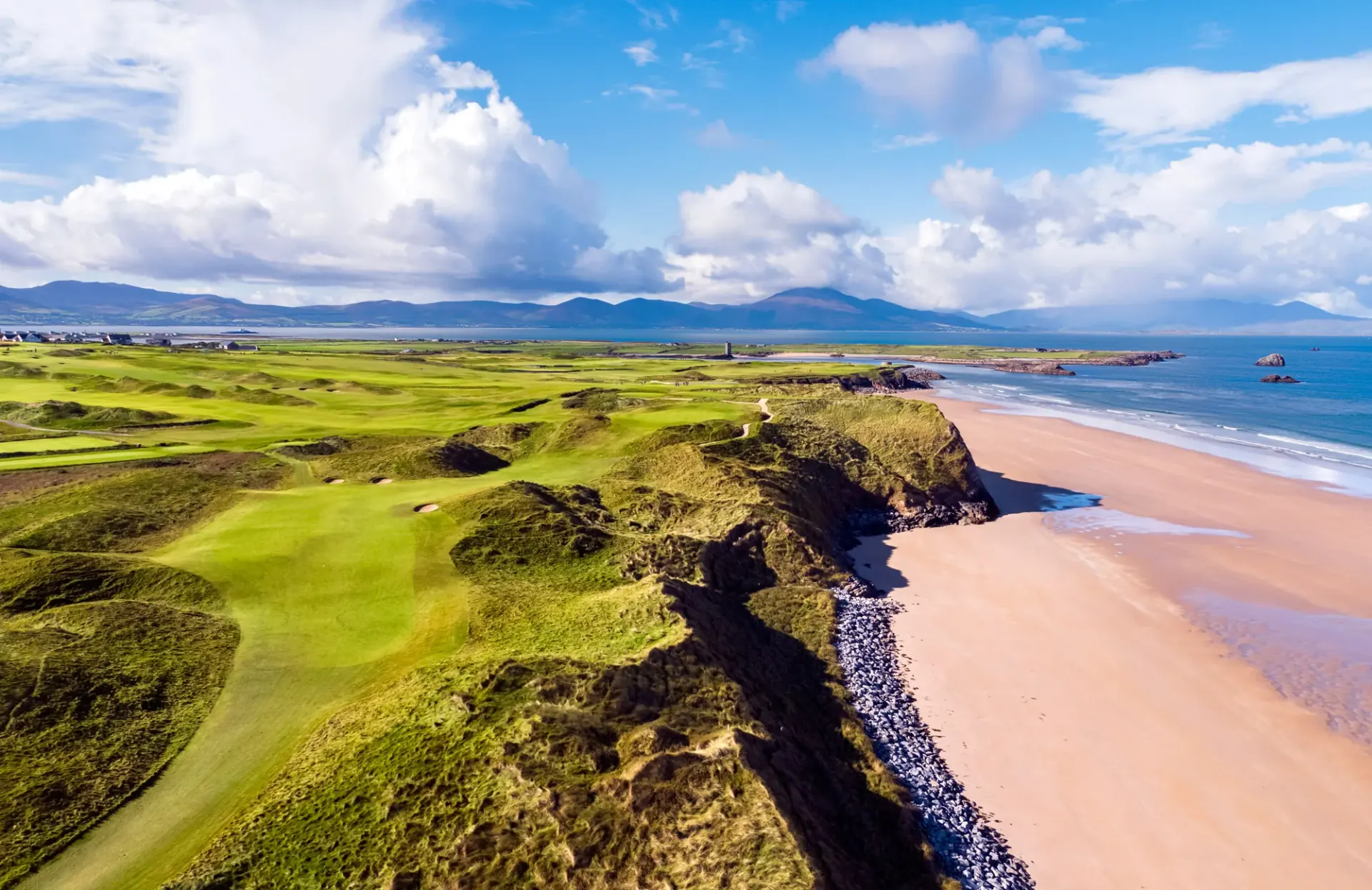
The course is modern compared with Ballybunion and Lahinch, but the land keeps it from feeling manufactured. Rocky coastline, beaches, dunes and high viewpoints shape the round, particularly after the turn.
The Front Nine
The front nine is sometimes treated as an opening act for what follows. That undersells it. The second bends around the cliff edge, and the short third sits beside the shoreline with a historic stone tower behind the green. Recent changes have also brought the eighth closer to the water and strengthened the coastal character of the outward side.
The front is broader and more exposed than the back. Wind direction is easier to read, but exposed shots beside the coast can still change quickly. It is the place to settle into the round before the routing enters the largest dunes.
The Back Nine
The back nine is why Tralee has its reputation. The course climbs, drops and turns through dunes where the next landing area or green is not always obvious from the previous shot.
The stretch from the 12th through the 16th supplies much of the drama. The 13th is a short hole played across a deep chasm, while the 16th sits among the dunes with the Atlantic beyond it. The closing holes remain exposed to the coast and wind, so the course does not ease back into the clubhouse.
This part of the round is visually spectacular, but it also asks for accurate distance control and realistic club selection. Choose tees that leave manageable approaches. Playing too far back makes the carries and uneven terrain needlessly difficult.
Walking and Caddies
Tralee identifies itself as a walking course. Buggies are reserved for medical purposes, while caddies, forecaddies and trolleys are available through the club.
A caddie is valuable on the back nine, where elevation, wind and partially hidden targets complicate yardages. Local guidance also helps determine where a miss is playable and where a dramatic-looking line creates unnecessary trouble.
The club's 2026 visitor schedule listed play on Monday, Tuesday, Thursday and Friday. Visitor days and access can change, so the Tralee tee time should be established before the rest of that part of the route is fixed.
Where to Stay and How Long
The course is at Barrow West outside Tralee, so the lodging decision is about the wider route rather than staying at an on-course resort. Choose a base around room setup, evening preferences and whether the next round is north toward Ballybunion or south toward Waterville.
One night is sufficient when Tralee is a single stop. Two nights give the group a more stable Kerry base and remove the need to pack immediately after a demanding round.
JEL's Tralee page places the course about two hours from Shannon Airport. That makes it possible as an opening or closing destination, but Lahinch is the more convenient first stop after landing at Shannon. Our Lahinch planning guide explains how that County Clare stage can lead into Kerry.
Pairing Tralee with Ballybunion
Ballybunion is the cleanest pairing. The clubs offer two different versions of links golf: Ballybunion's Old Course is historic, irregular and shaped by a long architectural evolution, while Tralee is a modern Palmer routing whose scale builds dramatically after the turn.
The Ballybunion planning guide recommends staying locally when its Old Course time is early. That can be followed by a move toward Tralee, rather than forcing both rounds from one hotel regardless of timing.
Continuing Toward Waterville
Waterville is the natural next major stop, but it is not a short local transfer. The route continues around the Iveragh Peninsula, and the travel time should be protected rather than inserted between two rushed rounds.
This is why Tralee often works as the middle stage of JEL's South West Ireland offering. It connects the northern Kerry courses with the more remote golf farther south.
The Southwest Ireland course guide can help the group decide which rounds deserve priority before the number of hotel changes is set.
Best Time to Go
JEL identifies May through September as the strongest period for Tralee. Those months offer longer daylight and generally milder conditions, but summer also brings the highest demand.
Spring and fall can work well when the group accepts more variable wind and rain. There is no dependable calm-weather month on this coastline, so waterproofs and flexible expectations are part of the trip.
Planning Considerations
- Give Tralee a full day. The back nine is too demanding to treat as a rushed transfer-day round.
- Confirm visitor access first. Published visitor days are limited and can determine the Kerry route.
- Choose suitable tees. The back-nine carries and elevation provide enough difficulty.
- Consider a caddie. Local help is most valuable once the course enters the dunes.
- Pair north and south deliberately. Ballybunion should precede Tralee, with Waterville following as the route moves down the peninsula.
- Use two nights when pace matters. It prevents another immediate hotel change after walking Tralee.
FAQ
How many nights should you stay near Tralee?
One night works for a direct stop. Two nights are better when Tralee serves as a central Kerry base or the group wants a slower pace.
Is Tralee a walking course?
Yes. The club describes Tralee as a walking course, with buggies reserved for medical purposes.
Should you take a caddie at Tralee?
A caddie is useful for wind, elevation and hidden targets, particularly across the back nine. Caddies and forecaddies should be arranged with the tee time.
Is the front nine worth discussing, or is Tralee only about the back?
The back nine is more dramatic, but the front has strong coastal holes and expansive views. It creates a different opening before the terrain becomes more enclosed after the turn.
What should you pair with Tralee?
Ballybunion is the best northern pairing. Waterville is the logical next major course as the route continues south through Kerry.
How far is Tralee from Shannon Airport?
JEL's destination page estimates approximately two hours by road. Actual time depends on the route and traffic.
Plan Your Trip with JEL
Tralee fits best when its visitor day, lodging base and the moves from Ballybunion toward Waterville are planned together. Send us your dates, group size and priority courses, and we can coordinate the golf, lodging and transportation around the route.


