


Waterville is not a course to add because there happens to be room between two other rounds. Its position on the Iveragh Peninsula makes it a deliberate stop, and the trip is better when the schedule treats it that way.
The course sits between Ballinskelligs Bay and the Atlantic, with mountain and water views throughout the property. It is expansive rather than cramped, and each hole turns differently through dunes or along the edges of the site. The wind rarely repeats itself from one shot to the next.
A Waterville golf trip should include enough time to reach the village, play without watching the clock and stay nearby afterward.
Quick Answer
Plan at least one night near Waterville. Two nights are better when the group wants a slower arrival, an unhurried round and a reasonable departure the following morning.
Waterville works naturally after Tralee as the trip continues south through County Kerry. Do not treat it as an easy out-and-back round from a distant base. Roads on the peninsula make the journey part of the day, and a late return after walking the course weakens the experience.
The Course and Its History
Golf in Waterville dates to the 19th century, but the modern championship course was completed in 1973. Irish-American businessman Jack Mulcahy led its revival, with Eddie Hackett and Masters champion Claude Harmon shaping the course. Tom Fazio later refined the routing, playing surfaces and visual consistency.
The result feels older than its modern history suggests. Firm turf, broad dunes and open coastal ground allow the ball to move after it lands. Waterville is not built around one signature view; the scale of the landscape stays present throughout the round.
The par-72 course offers five sets of tees, from roughly 5,370 yards to more than 7,300. That range matters. The wind can add substantial effective distance, and choosing the wrong tees turns strategic par 4s and 5s into repeated long approaches.
How Waterville Plays
Waterville has four par 3s, ten par 4s and four par 5s, with holes moving in different directions across the property. The variety prevents one wind from affecting an entire side in the same way.
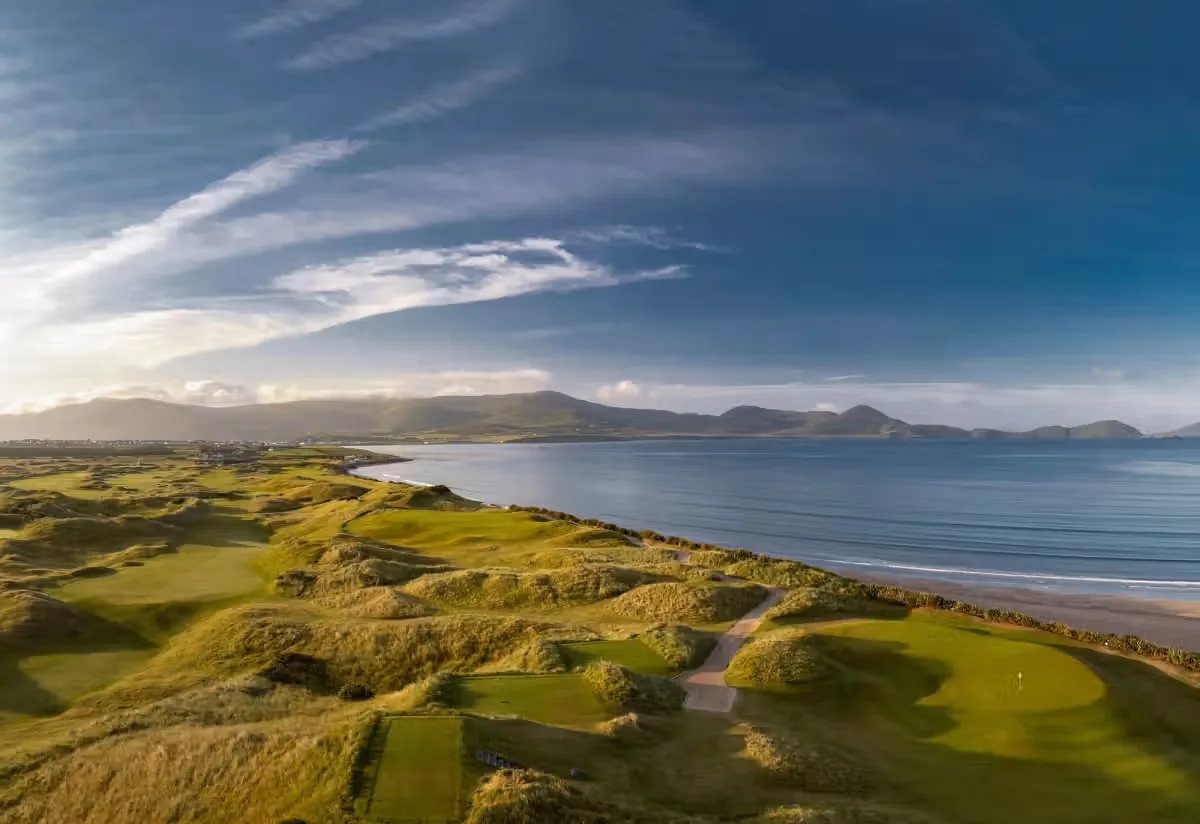
The course begins with space and broad views before moving through stronger dunes. Firm conditions create opportunities to use the ground, but the safest landing area is not always the best angle into the next shot. Bunkering and green orientation reward players who think beyond simply finding the widest part of the fairway.
The back nine supplies many of the strongest holes. Waterville returns to the shoreline for the finish, beginning with a risk-and-reward stretch where the ocean becomes part of the strategy rather than scenery in the distance.
The 16th bends toward the water and asks how much of the coastal line the player is willing to challenge. The 17th is a high, exposed par 3 with a wide view across the property. The par-5 18th runs beside the beach, leaving the wind and shoreline involved until the final approach.
Walking, Wind and Caddies
Waterville is best understood on foot. The course covers substantial ground, but walking keeps the scale, transitions and changes in wind connected from hole to hole.
A caddie can help with landing areas, runouts and the effect of the wind around the dunes. That local information becomes especially useful late in the round, when the coastal holes present tempting lines that may be more aggressive than they first appear.
Select tees conservatively. Waterville has enough width to remain playable, but the course becomes long quickly in a heavy wind. A manageable approach allows the group to use the slopes and firm turf instead of repeatedly trying to carry the ball to distant greens.
Where to Stay and How Long
Waterville should be treated as its own overnight stop. JEL's destination page recommends two to three nights for the broader experience, while a tightly routed golf trip can use one or two depending on arrival time and the following destination.
The index does not identify a specific hotel that every group should use. Lodging should be selected around group size, room occupancy and transportation, with priority given to staying close enough that the round is not surrounded by two long drives.
One night works when the group arrives from Tralee with time to settle in, plays Waterville the following day and continues onward the next morning. Two nights remove pressure from both sides of the round.
Pairing Waterville with Tralee
Tralee is the logical course before Waterville. Its dramatic back nine provides a different experience from Waterville's broader, more expansive routing.
The Tralee planning guide positions that course as the middle of the County Kerry route. After Tralee, the group should allow a dedicated transfer toward Waterville rather than expecting another short local drive.
Ballybunion can come earlier in the same sequence. The Ballybunion guide explains why an overnight stay there may be useful before continuing through Tralee and toward the Iveragh Peninsula.
Continuing the Southwest Ireland Route
Waterville is often the southern end of the Kerry portion of JEL's South West Ireland offering. If the trip continues toward Kinsale and Old Head, the move should be given its own travel allowance rather than combined with a rushed morning round.
The Southwest Ireland course guide compares the golf represented in JEL's regional inventory. Use it to decide whether the group needs every major course or would be better with fewer rounds and more time at each stop.
Best Time to Go
JEL identifies May through September as the strongest period for Waterville. Summer provides long daylight and generally milder temperatures, while July and August bring the greatest demand.
Spring and fall can still work well, but cooler weather, rain and stronger wind are more likely to affect the day. Proper waterproofs and layered clothing belong in the bag in every season.
Planning Considerations
- Stay near the course. Waterville is too remote to surround with unnecessary driving.
- Allow a full golf day. Do not combine the round with a major hotel move.
- Choose practical tees. Wind can make the course play much longer than its listed yardage.
- Use Tralee as the previous stage. It creates a logical southbound route through Kerry.
- Keep the next morning flexible. The road out of the peninsula deserves realistic timing.
- Consider a caddie. Local knowledge helps with angles, runouts and the coastal finish.
FAQ
How many nights should you stay near Waterville?
One night can work in an efficient route. Two nights are better for groups that want a relaxed arrival and departure around the round.
Is Waterville close to Shannon Airport?
No. JEL's destination page estimates approximately three hours by road from Shannon Airport, which is why Waterville normally belongs later in a regional itinerary.
Is Waterville difficult to walk?
The property covers substantial ground and wind adds to the physical challenge. Golfers comfortable walking a full links course should be prepared for an exposed day.
Should you take a caddie at Waterville?
A caddie is useful for wind, landing areas and the firm ground game. Availability should be coordinated with the tee time.
What should you pair with Waterville?
Tralee is the strongest immediate pairing, with Ballybunion fitting earlier in the same County Kerry route.
Why is Waterville worth the extra travel?
The remote position creates the setting: expansive dunes, Ballinskelligs Bay, Atlantic wind and a strong coastal finish. It feels like a destination rather than another stop near a city.
Plan Your Trip with JEL
Waterville works best when its tee time, local stay and the transfers from Tralee and onward are planned together. Send us your dates, group size and priority courses, and we can coordinate the golf, lodging and transportation around the route.


